The Rubaiyat in music and spoken word
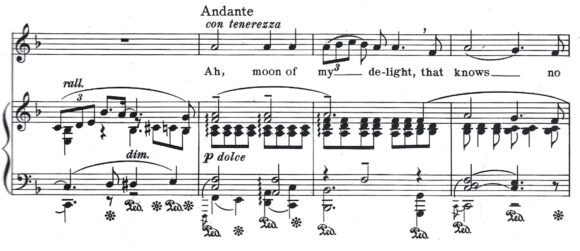
Liza Lehmann – In a Persian Garden
Already in the 1880’s Omar’s quatrains found their way into musical compositions. The oldest one found so far is a song cycle by August Riedel: Liebesgesänge (1882) based on the German translation by Friedrich Bodenstedt (1881). A second German composition was done by Felix von Woyrsch: Drie Persische Lieder (1884), also based on Bodenstedt. It was Liza Lehmann’s song-cycle In a Persian Garden (1896) that became very popular. It was performed and recorded many times, even up to our days. Since then a variety of musical styles or genres has been created: modern popular music, classical music, film scores, orchestral works and piano pieces but also jazz, folk and pop songs.
Strictly speaking ‘the rubáiyát in music’ deals with quatrains that are sung, that is: the words set to music. There are many instrumental works however, inspired by Khayyám’s verses. Among these are compositions that only refer to Khayyám or his rubáiyát in their titles. Another category is the music that serves as ‘background music’ in films, documentaries, presentations etc.
This chapter also deals with narrated versions of the Rubaiyat.
The section Classical music entails a wide range of ‘classical’ music, not only the traditional symphonic of chamber music but also contemporary, avant-garde compositions. The records refer to compositions, not recordings, but with a few exceptions.
Language and translator
This table shows the highest numbers of compositions per language and translator (updates will follow in due course)
| English | French | German |
| FitzGerald – 88 | Toussaint – 7 | Rosen – 6 |
| Others – 7 | Roger-Cornaz – 4 | Bodenstedt – 3 |
| Unknown – 35 | Others – 9 | Von Schack – 2 |
| Unknown – 7 | Others – 3 | |
| Unknown – 13 |
The majority of works with an English text, labeled as ‘Translator-Unknown’ are probably based on a FitzGerald version.
Most common settings
| Voice and piano: 83 |
| Voice and ensemble: 54 |
Number of compositions per decade
The graph shows a total of all classical works (235, blue line), and the totals of works for Voice and Piano (B-1) (83, red line) and for Voice and Ensemble (B-3) (54, yellow line)
Note
The inventory is by no means complete. There are many more sources to be explored. Additions are welcome, please use to Reply form below
The Non-classical music section includes various genres such as jazz, blues, pop and world music. The works in these genres generally exist as recordings, and as the names of composers and translators are rarely mentioned, performers (singers, bands etc.) are also listed.
Another spin-off is that of the narrated version that consists of LP’s, CD’s, cassette tapes, audio books and internet versions (such as YouTube items). Some of these recordings have accompanying or background music, the main focus however is on the texts.
On FitzGerald’s translation
The majority of compositions on the Rubaiyat are based on FitzGerald’s translation, which is no surprise of course, as far as works by ‘western’ composers are concerned. In the ‘Text from’ dropdown filter, the ‘Unknown’ option retrieves a number of works whose author (translator) is unidentified. Probably most of the English works use Fitzgerald’s verses, the sources however don’t tell.
FitzGerald is identified as the source of the texts when he is mentioned in the work and when a title or a text fragment clearly refers to his translation. Also when he is identified in the reference works that I used.
On instrumental works
This category of works is included although in some cases a work might be titled “Rubaiyat” or “Omar Khayyam” at the composers’ own discretion: is it inspired by or just called that way?
On narrated versions
Not included are recordings of documentaries, interviews etc., in which quatrains are quoted, for instance to substantiate a certain view.
On non-classical music
A number of popular music recordings are not available via the usual media (LP, CD, Cassette etc.), but only on online digital platforms such as YouTube, Spotify, SoundCloud, BandCamp etc.
Some recordings were issued as LP and CD (i.g. Dorothy Ashbee)
Thank you for this Jos