Omar Khayyám on theodicy

Omar Khayyám on theodicy. Irreconcilability of the transcendental and the imminent. Mehdi Aminrazavi
In: Journal of Islamic Philosophy, 11 (2019), p. 33-44.

Abstract

The philosophical and theological thoughts of Omar Khayyām, the Persian mathematician, astronomer, and the likely author of the Rubāʿiyyāt (Quatrains), has remained a neglected area of scholarship. Much of the scholarship on Khayyām in the last few centuries has primarily been focused on his Quatrains, and to a lesser extent, on his views on mathematics and geometry. Despite Khayyām’s significance, his six philosophical treatises were not even edited nor published until recently, which is perhaps why they have remained relatively obscure. In this article, Khayyām’s dual views on theodicy are presented notwithstanding that he is the only figure we know of in the annals of Islamic intellectual history who adopted two opposite positions—simultaneously— with regard to the problem of evil. This article postulates that Khayyām’s dual positions on theodicy can only be understood if they are placed in their proper contexts; philosophically, theodicy is explainable, while on a more experiential level it is not. Conclusions may vary, depending on whether we are looking at the presence of evil from a transcendental or an imminent perspective.
 

Martin Heidegger and Omar Khayyam on the Question of “Thereness” (Dasein)

Martin Heidegger and Omar Khayyam on the Question of “Thereness” (Dasein). M. Aminrazavi.
In: Islamic philosophy and occidental phenomenology on the perennial microcosm and macrocosm. Dordrecht, Springer, 2006. Vol. 2, pp. 277-287.

In comparing two philosophers who belong to two distinct philosophical traditions, one often runs the risk of superficiality. That is, by finding similarities, either conceptual or linguistic, one may conclude that the thinkers in question are advocating the same concepts. One may go further and ask, “So what if the two figures belonging to two different schools of thought agree with respect to one or a set of ideas?”

Reading the Rubá’iyyát as “resistance literature”

Reading the Rubá’iyyát as “resistance literature”. Mehdi Aminrazavi.
In: The great ‘Umar Khayyám. Leiden, Leiden University Press, 2012. pp. 39-53.

Aminrazavi argues that many of the Rubáiyát were written as a reaction to the rise of Islamic orthodoxy and the demise of the intellectual freedom which was so prevalent in the first four centuries of the Islamic history. He argues that once Khayyám’s Rubáiyát are placed within the historical context of his time, they will no longer appear to be the pessimistic existential bemoaning of a poet-philosopher like Schopenhauer. Rather, one can see the Rubáiyát as an intellectual critique of the rise of orthodox and legalistic Islam as represented by the faith-based theology of the Ash‘arite.

Umar Khayyam

Umar Khayyam. Mehdi Aminrazavi; Glen van Brummelen
In: The Stanford Encyclopedia of Philosophy, Spring 2017

Summary

The authors argue that Umar Khayyam was a philosopher-sage (ḥakīm) and a spiritual-pragmatist whose Rubā‘iyyāt should be seen as a philosophical commentary on the human condition. The salient features of Umar Khayyam’s pioneering work in various branches of mathematics were also discussed. Khayyam’s mathematical genius not only produced the most accurate calendar to date, but the issues he treated remained pertinent up until the modern period. For Khayyam, there are two discourses, each of which pertains to one dimension of human existence: philosophical and poetic. Philosophically, Khayyam was the last Peripatetic in the Persian speaking world before philosophical thinking eclipsed the Eastern part of the Islamic world for several centuries. Khayyam defended rationalism against the rise of orthodoxy and made an attempt to revive the spirit of rationalism which was so prevalent in the first four centuries in Islam. Poetically, Khayyam represents a voice of protest against what he regards to be a fundamentally unjust world. Many people found in him a voice they needed to hear, and centuries after he had died his works became a venue for those who were experiencing the same trials and tribulations as Khayyam had.

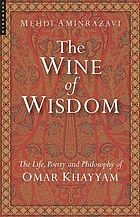
The wine of wisdom. The life, poetry and philosophy of Omar Khayyam

The wine of wisdom. The life, poetry and philosophy of Omar Khayyam. Mehdi Aminrazavi. Oxford, Oneworld Publishing, 2005. 396 p. ISBN: 1-85168-355-0.

Summary:
The intoxicating message of Khayyam’s famous Ruba‘iyyat created an image of exotic Orientalism in the West but, as author Mehdi Aminrazavi reveals, Khayyam’s achievements went far beyond the intoxicating message within these verses. Philosopher, mathematician, scientist, and mystic – his many different identities are examined here in detail, creating a coherent picture of this complex and often misunderstood figure.

Contents

Acknowledgements
Introduction
1. Khayyam’s life and works
2. Reconstructing a tarnished image: Omar Khayyam according to his contemporaries and biographers
3. Khayyam within the intellectual context of his time
4. The Ruba’iyyat
5. Khayyam and sufism
6. Khayyam’s philosophical thought
7. Khayyam the scientist
8. Khayyam in the west
Epilogue
Appendix A: Translations of the philosophical treatises
Appendix B: The Ruba’iyyat – Edward FitzGerald’s translation
Appendix C: Arabic poems of Omar Khayyam
Notes
Bibliography
Index