Abandon the Day

Abandon the Day: FitzGerald’s Rubáiyát of Omar Khayyám. David Sonstroem
In: The Victorian Newsletter, 1969, no. 36, p. 11-14

EDWARD FITZGERALD’S Rubaiyat of Omar Khayyam bravely offers its famous remedy, “A Book of Verses … / A Jug of Wine, a Loaf of Bread-and Thou”, as triumphant insulation against the thought of eternal extinction. But this quatrain, like some other passages expressing optimism or satisfaction, is rather out of keeping with the rest of the poem, whose overall impression is of helpless, sodden pessimism and richly melancholic despair. The poem as a whole offers a suggestive departure from the carpe diem sentiments found in this quatrain, introducing the traditional motif only to belie it. By this means the poem achieves an especially poignant-and peculiarly Victorian-pathos.

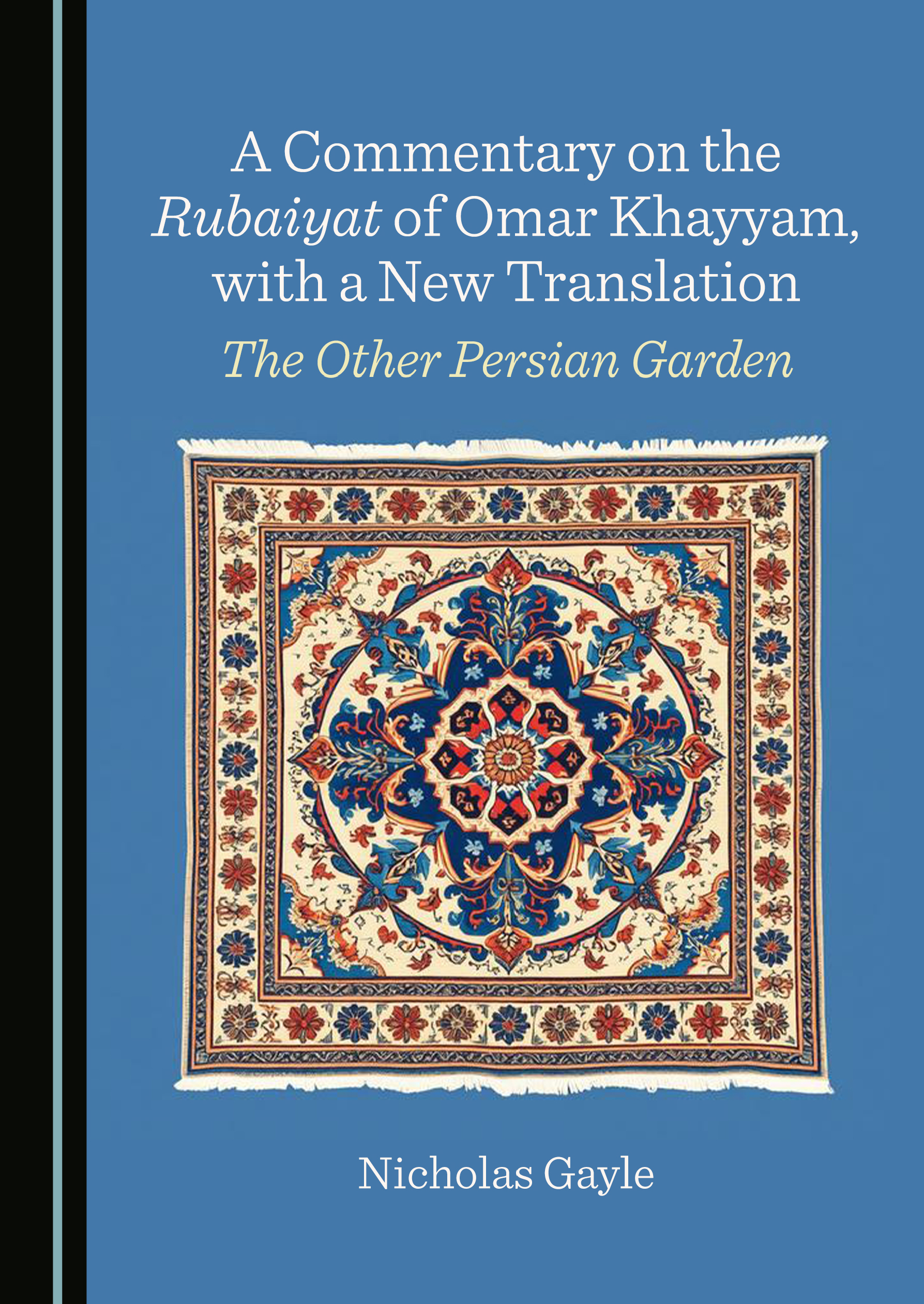
A Commentary on the Rubaiyat of Omar Khayyam, with a New Translation

A Commentary on the Rubaiyat of Omar Khayyam, with a New Translation. The Other Persian Garden. Nicholas Gayle.  Newcastle upon Tyne, Cambridge Scholars Publishing, 2026. ISBN: 978-1-0364-7201-6.

For generations FitzGerald’s lyrical and exotic versions of the Persian poetry of Omar Khayyam—the Rubaiyat—have provided some of the best-loved and most quoted lines in English verse, yet he left 114 poems in his source manuscript untouched. What of these poems? Here they are, not just newly minted in English verse, but accompanied by a detailed Commentary examining the various historical, social, and religious issues the poems throw up, one addressed to both academics and general readers alike. It turns out that through its exploration of mystical and sensual love, of human hope, doubt, and psychological resignation, the world of medieval Persian poetry can offer an oblique mirror to remind us we have never been modern.

The Loveliest and the Best

The Loveliest and the Best: The Tapestry of Influence of Omar Khayyám’s Rubáiyat on the Works of Bob Dylan. John M. Radosta
In: Dylan Review Vol. 5.2, Fall/Winter 2023-2024

When Omar Khayyám began writing quatrains, called rubáiyát in his native Persian, it was perhaps to escape from his extensive work on algebra and astronomy. He could not have had any idea that his poetry would become the first link in a chain of collaboration that stretched ten centuries or more into the future. Among the most prominent luminaries who have come under Khayyám’s spell are T.S. Eliot and Woody Guthrie. But one of the most important links, one that encompasses both Eliot and Guthrie, is Bob Dylan. From the “Persian drunkard” in “Absolutely Sweet Marie” to the many direct allusions on the 2012 album Tempest, and culminating on 2020’s Rough and Rowdy Ways, Dylan has filled his cup with Omar’s views and fermented them into his own poetic transformations. Both of these artists have fomented change through long term impacts on society, and in conversation across millennia they continue to decant their ideas in ever-fresh vintages.

The Awakening Wine

The Awakening Wine: A Contextual and Philosophical Reading of Khayyam’s Rubaiyat. Nayeb Ghodrat Gojar
In: Cankaya University Journal of Humanities and Social Sciences, 20, 2026, p. 157-173

This article offers a philosophical and contextual analysis of the metaphor of “wine” in Omar Khayyam’s Rubaiyat, challenging reductive interpretations that associate Khayyam solely with hedonism and secularism. Drawing upon a clearly defined corpus of quatrains authenticated by leading Khayyam scholars, including Abdolhossein Zarrinkoob, Abdolhamid Gheibi, and Abdülbaki Gölpınarlı, the study argues that Khayyam’s frequent invocation of wine functions as a profound metaphor for spiritual awakening, existential inquiry, and intellectual liberation. Rather than promoting literal intoxication, Khayyam employs wine to critique religious hypocrisy, emphasize the fleeting nature of life, and advocate for a conscious, wisdom-driven engagement with the present. The article examines the deep roots of wine symbolism within the Persian hamriyye (wine poetry) tradition, tracing its development from pre-Islamic ritual through Sufi mystical appropriation. It also examines how specific Western translators, including Edward FitzGerald, Friedrich Rückert, and J. B. Nicolas, have distorted Khayyam’s original metaphysical intentions by reinterpreting his symbolic motifs within culturally alien frameworks. By situating Khayyam’s poetry within its historical, linguistic, and intellectual contexts, and by engaging closely with authenticated Persian quatrains alongside their English translations, the study reclaims the richness of his symbolic language and restores the philosophical integrity of his worldview. Therefore, the article highlights how Khayyam’s quatrains transcend cultural and temporal boundaries, offering a timeless call to self-awareness, moral clarity, and existential authenticity.
Rural Rubaiyat

Rural Rubaiyat
In: Examiner (Launceston, Tas. : 1900 – 1954), 22 jan 1948, Page 2

1 quatrain

Some worry much …

Some worry much … S.L.F.
In: The bulletin. Vol. 28 No. 1411 (28 Feb 1907)

One of a number of entries for a competition

1 quatrain